Threpwick
About

A physical universe first, and a game second.

Most fantasy worlds are a description that reacts to you — text that agrees you are in a tavern for as long as you keep saying so. Threpwick is built the other way round. There is a world, made of cubes, with rules; you are one more thing standing in it, and it does not need you there to carry on.


The doctrine

The world is based on facts — the storyteller narrates those facts

This is the rule that everything is based on. We want to make sure that our AI narrator doesn't lie, so we've spent a lot of time making sure that it is based on pre-determined facts, rather than making stuff up, so while we allow actions and narration to add colour to the world, the pictures are already sketched out before AI gets anywhere near it.

The engine decides

Where you are. What is around you. Whether that door is open. Whether you may cross that square, who else can see you, what floor you are on, whether the staircase actually connects — and whether anything happened at all. Every one of those is a query against the world's own state.

The storyteller narrates

Esmira turns what the engine resolved into English. She is given structured facts, and she chooses the words for them. She does not choose the facts. She cannot move you, open anything, or decide that you succeeded — and when she is wrong about a sentence, the world is still right about the square.

Put plainly: nothing in Threpwick is true because something said it convincingly.


How it is made

Nothing is impassable because of its name

One five-foot grid runs under the whole region, and every cube in it is a row with physical properties — how solid it is, what it costs to cross, whether it can be seen through, whether it burns, whether it breaks.

A brick wall stops you because its row says movement is not allowed. Damage that wall and it becomes a different row, with a quarter of the solidity. Knock it down and what is left is rubble — which you can walk over, slowly, because rubble's row says so. No new engine code was written for any of that. It is the same three columns, holding different numbers.

  • Coordinates are immutable — a place cannot quietly become somewhere else
  • Ground is computed, not stored; a square becomes real once somebody stands in it
  • Everything physical is located the same way — people, barrels, carts, the dead
  • Carve a doorframe and the carving belongs to the cube, not to your session
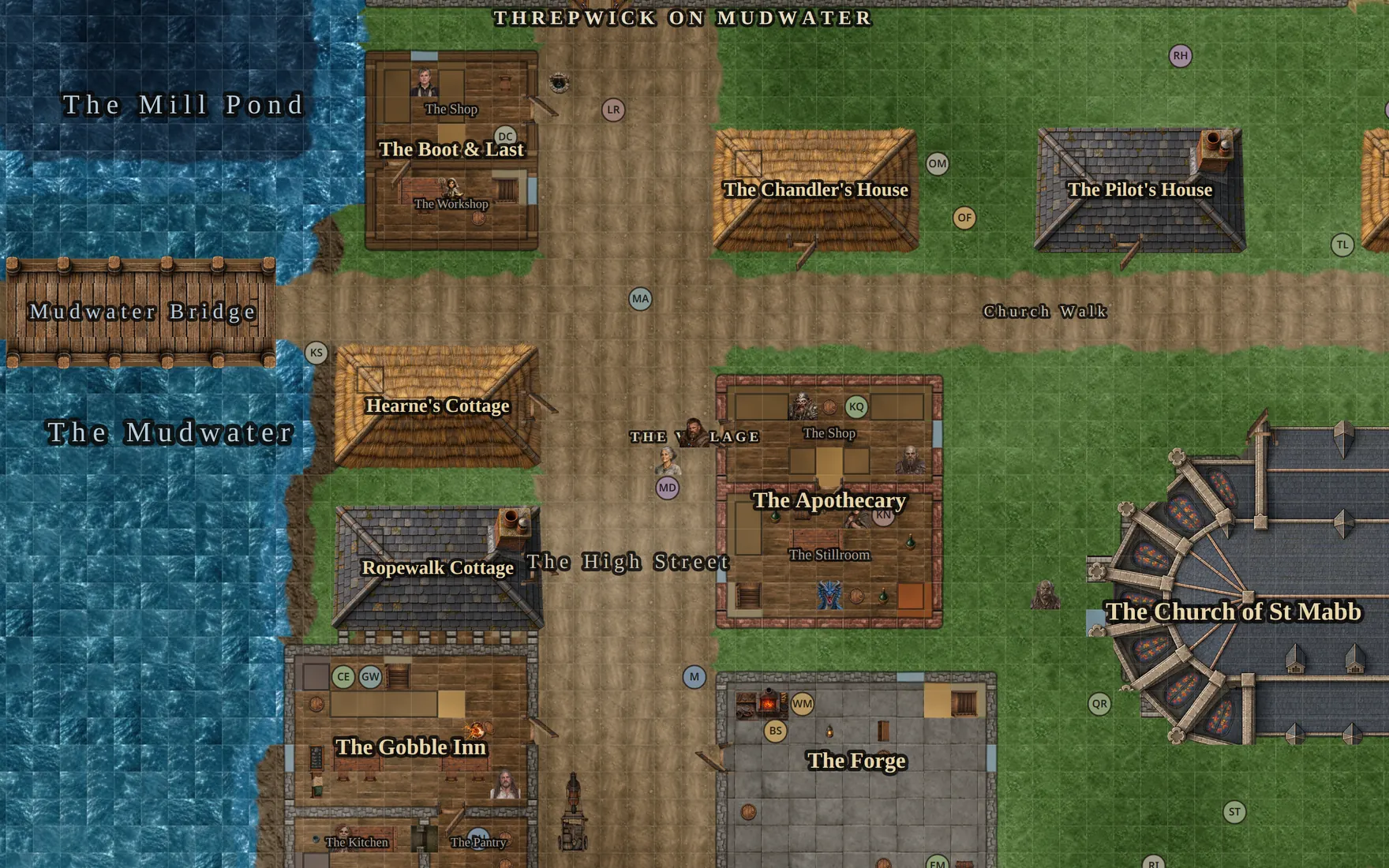
The High Street rendered in close: the Gobble Inn, the Forge, the Apothecary and townsfolk standing in the road.
The rules on top

The ruleset comes off

The world and the game are deliberately not the same layer. The world says this person wants to move from here to there. The ruleset says whether they may, what it costs them, and what it does to them.

Today that ruleset is D&D 5th Edition — movement, characters, spells, rests, conditions. It lives in its own package, and swapping it would not change one cube. That separation is not a promise about what is coming next; it is how the code had to be arranged for the physics to stay honest.

  • The dice are thrown with real physics — where they stop is the number
  • You throw the d20 and its damage dice together, as you would at a table
  • Miss, and the dice already lying there simply do not count
  • Nothing is decided in advance and animated afterwards
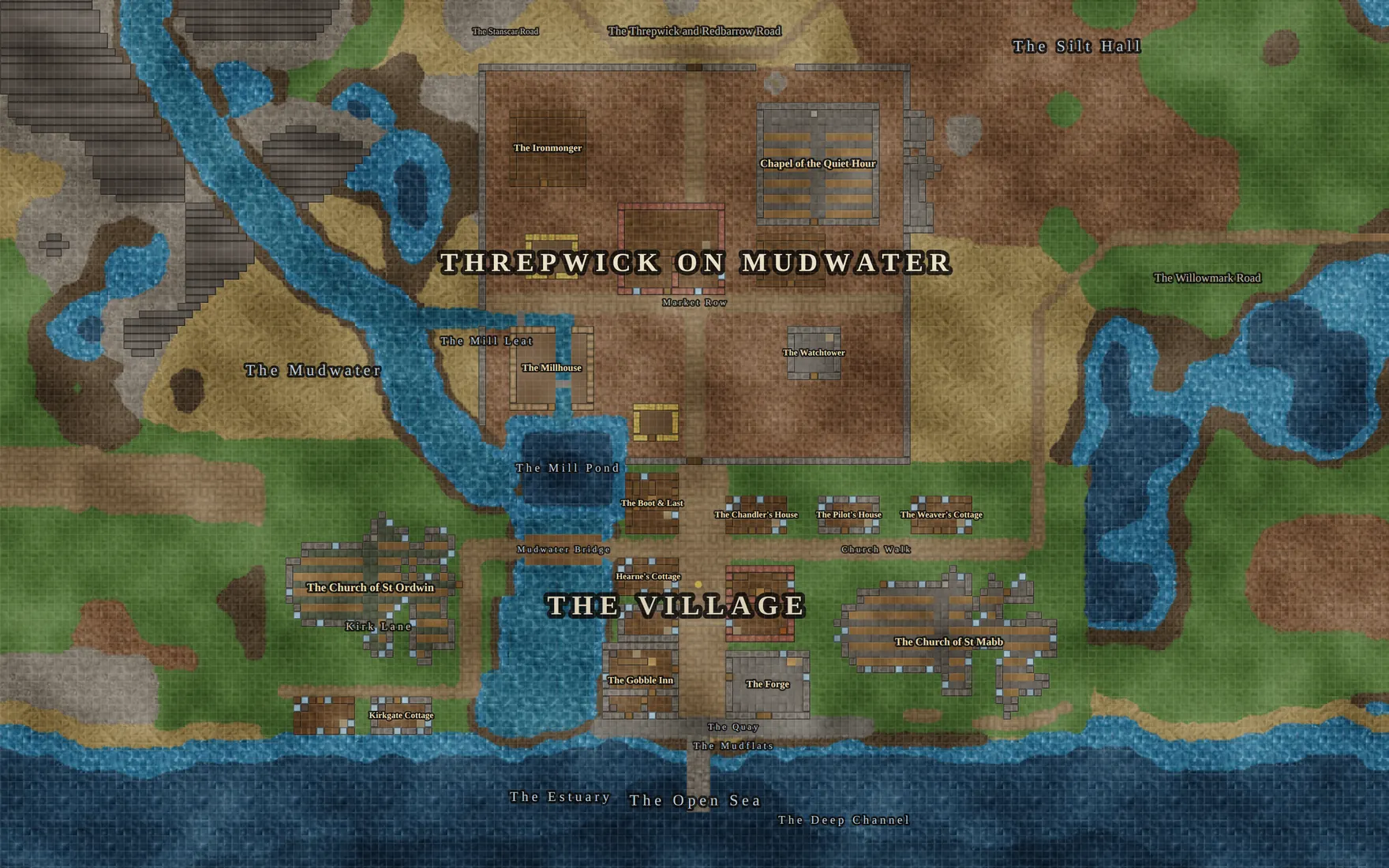
The map of Threpwick on Mudwater: town walls, the High Street, the Mill Pond and the roads out.

How it is checked

A cathedral you cannot get into is a failing test

A world this literal can be wrong in ways prose never can — a room with no door, a stair to nowhere, a road that stops at the water. So it is audited rather than trusted.

Everything reachable

A proof suite walks the region and demands that every room and every door can actually be got to. When that fails it is a bug with a location, not a story somebody has to write around.

Deterministic underneath

The same seed builds the same terrain, and the step that turns world state into narrative facts involves no model at all. It is the same answer every time, which is what makes a wrong one findable.

Roads were searched for

No road was drawn by hand. Each was pathfound over the real terrain, round the crags and the meres — and where one has to cross water it becomes a timber deck, because a road does not go through an estuary.


Where it came from

It grew out of an inn

Threpwick is made by Real Wizardry, and it started inside something much smaller: the Gobble Inn, the tavern that Real Wizardry's audience has been poking at for years. The inn needed a street. The street needed a town that made sense around it. The town needed somewhere its wool and its stone and its fish were actually coming from — and by the time that question had been answered properly there were seven settlements, real roads between them, and an estuary with a tide.

It is now entirely its own thing: its own database, its own code, its own service, with nothing imported from the play area it grew out of. What carried across was one dwarf's numbers and his portrait, copied over by hand.

The world is still being built, and it grows faster than a page can keep up with — the population quoted on the front page was 673 only three days before that page was written. The counts you see there are real counts, taken from the database on the day they were published, not estimates.

Plainly

The things worth saying straight

Is this finished?

No, and it is sold as what it is. The region is built and live and you can walk around it today; new things land regularly. If what you want is a finished, boxed game, this is not that yet.

Do I need anything to do with Real Wizardry to play?

No. Threpwick has its own account, its own door and its own price, and none of it is tied to a Real Wizardry membership, channel or shop order. Real Wizardry is who makes it — that is the whole of the connection you are required to care about.

What happens to what I do in it?

It stays. Marks you cut and things you shove are tied to the place and the square rather than to your visit, so they are still there when you come back to look.

What does the £15 buy?

A month's access to the world, and each payment buys its own month — nothing bills you automatically, so stopping is simply not paying again. Paying early adds to what you have left rather than replacing it.

Step into the world →

£15 a month · cancel whenever you like